Introducing Japan to Jesus Through the Language They Love.
A new kind of museum invites visitors to explore Japanese kanji and discover the story they never expected to find.

Japan is one of the world's largest unreached nations. Renowned for its natural beauty, rich history, remarkable craftsmanship, and warm hospitality, it welcomes millions of visitors from around the world each year. Yet for many Japanese people, the message of Jesus Christ remains unfamiliar. Most have never had the opportunity to hear a clear presentation of the Gospel or to open a Bible for themselves.
Each year, more than 8 million people visit the mountain resort town of Karuizawa. They come seeking rest, inspiration, beauty, and meaningful experiences with family and friends. Beneath the surface, however, many are asking the same timeless questions that people everywhere ask: Why am I here? Is there hope beyond this life? Where can lasting peace be found?
The Gospel Kanji Museum is more than a collection of exhibits. It is an invitation to explore the greatest story ever told.
As visitors walk through the museum, they encounter a series of Kanji, whose parts point to historical Biblical events. Each one is presented as a beautifully crafted scroll. Every scroll combines the character itself, its individual parts, the Bible passages, and original artwork portraying the biblical event the kanji are illustrating. Like small masterpieces, each kanji exhibit invites visitors to slow down, look closely, ask questions, and discover connections they may never have imagined before.
Whether someone spends ten minutes or an hour inside the museum, our prayer is that they leave with something they did not have when they entered: a new understanding of God's Word, a deeper curiosity about Jesus, and a desire to continue exploring the greatest story ever told.


“but to those who are the called, both Jews and Greeks, Christ the power of God and the wisdom of God.” 1 Corinthians 1:24
Isaiah wrote of the Servant, “The LORD called Me from the womb… He has made My mouth like a sharp sword… He made Me a select arrow; in His quiver He hid Me” (Isaiah 49:1–2).
In the Old Testament, the mouth and the arrow appear together in one remarkable picture. Concealed in the hand of God. Hidden until the appointed time. The arrow and the mouth together form the image of Christ being prepared before His revelation.
When we turn to the New Testament, Paul declares what Isaiah’s imagery anticipated: “Christ the power of God and the wisdom of God” (1 Corinthians 1:24). Power and wisdom are what the Magi sought all their lives, and they find both in Christ.
The kanji for wisdom, 知, is formed of two parts: arrow 矢 and mouth 口. In Isaiah, the arrow and mouth describe the Christ Child concealed in the womb. Paul writes that Christ is revealed as the wisdom of God. In this one character 知, the Old Testament illustration and the New Testament revelation converge.
Paul also writes that in Christ “are hidden all the treasures of wisdom and knowledge” (Colossians 2:3). Hidden, just as the polished arrow was hidden in the quiver. “It is the glory of God to conceal a matter. It is the glory of kings to search out a matter” (Proverbs 25:2). In Japanese usage, 知 appears in words for news or announcement, the making known of what was once concealed.
God concealed the matter, and the Magi came searching, asking, “Where is He who has been born King of the Jews?” (Matthew 2:2).
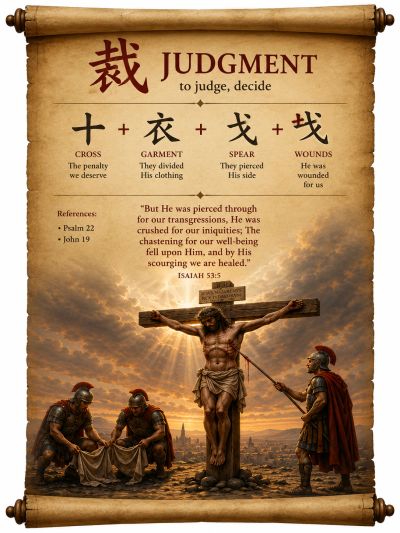
“But He was pierced through for our transgressions, He was crushed for our iniquities; The chastening for our well-being fell upon Him, and by His scourging we are healed.”
Isaiah 53:5
Scripture foretold the exact form that judgment would take. Zechariah said they would look on the One they pierced (Zechariah 12:10; cf. Psalm 22:16). Isaiah said He would be wounded for our transgressions and crushed for our iniquities (Isaiah 53:5). David recorded that His garments would be divided and lots cast for His clothing (Psalm 22:18). These prophecies converge at one place and one time, the crucifixion of Christ in John 19.
The kanji for judgment, 裁, gathers these details into a single image, like a tiny masterpiece of art. It is formed from four parts: the cross 十, the garment 衣, the spear 戈, and the wounds 𢦏. Each element appears at the cross. Christ is lifted up (John 12:31-33). He is pierced and wounded. His garments are taken. That testimony remains embedded in the character for judgment to this day.
After the resurrection, this same testimony is affirmed by Thomas. He said he would not believe unless he put his fingers into the wounds and his hand into Jesus’ side (John 20:25). When Jesus appeared and invited him to see and touch the wound, Thomas answered, “My Lord and my God” (John 20:28). Jesus then said, “Blessed are those who did not see, and yet believed” (John 20:29).
God did not merely reveal sin. He judged it. Paul explains, "For what the Law could not do, weak as it was through the flesh, God did: sending His own Son in the likeness of sinful flesh and as an offering for sin, He condemned sin in the flesh," (Romans 8:3).
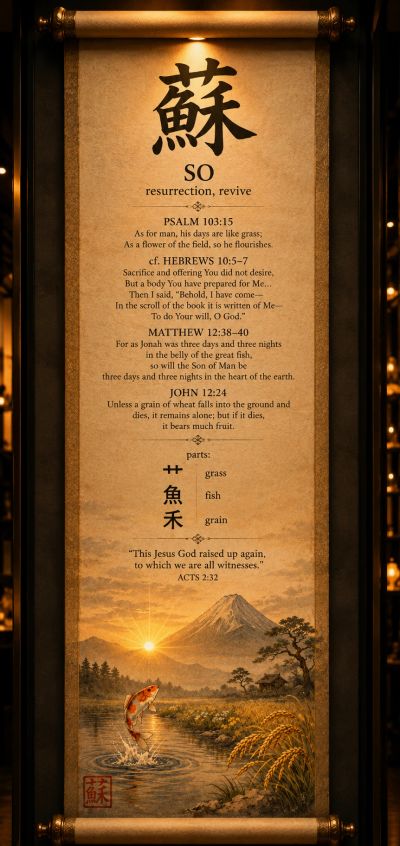
“This Jesus God raised up again, to which we are all witnesses.” Acts 2:32
When the wise men heard the apostles speak in Jerusalem in their own tongue, one truth stood above all others. God the Father had raised Jesus from the dead. It’s that moment they went back to when they designed and built the kanji for the name of Jesus 耶蘇.
The first character in the name of Jesus, Ye 耶, points directly to God, the Father. The second character, So/Su 蘇, means resurrection, and its parts reflect the very words Jesus spoke about His death and resurrection.
The top element in resurrection is grass, reflecting human mortality. Scripture tells us that all flesh is like grass that withers and fades. Jesus Himself spoke of this reality when He said, “A body You have prepared for Me.” He took on a real human body, a body subject to death (Psalm 103:15; cf. Hebrews 10:5–7).
The next element, fish, points to the sign Jesus gave concerning His burial. When asked for proof, He said that no sign would be given this evil and adulterous generation except the sign of Jonah. “Just as Jonah was three days and three nights in the belly of the great fish, so the Son of Man would be three days and three nights in the heart of the earth” (Matthew 12:38–40).
The final element, grain, comes from Jesus’ own teaching about resurrection life. He said that, “unless a grain of wheat falls into the ground and dies, it remains alone. But if it dies, it bears much fruit. His death was not an end. It was the beginning of new life for many” (John 12:24).
Together, Yesu 耶蘇 declares the gospel simply and clearly. The Father sent the Son. The Son took on mortal flesh. He was buried and God raised Him from the dead, bringing life to the world.
“So faith comes from hearing, and hearing by the word of Christ.” Romans 10:17
The cry of our hearts was simple and sincere. Mankind wanted God to reveal Himself and to tell them who He was. They were not asking for more knowledge for its own sake. They were searching for truth that could answer the problem of death. God answered them in two stages, exactly as He had promised.
First, He showed them His Son. In Bethlehem, we saw the Word made flesh. The Child born of a woman. They fell to the ground and worshiped Him. God had come in human form.
Three decades later, God told us more. At Pentecost, we heard the Word of Christ proclaimed. In our own languages, the message of His death and resurrection pierced our hearts.
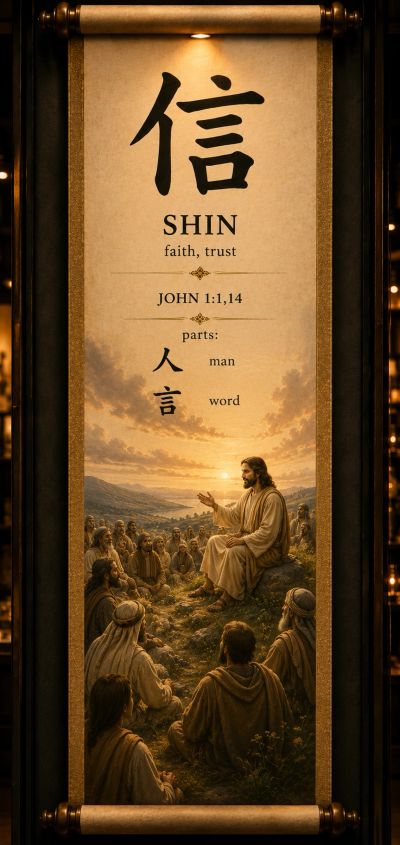
Scripture says that Jesus is the author and perfecter of faith 信 (Hebrews 12:2). God had promised Moses that He would raise up a man 人 who would speak 言 the very words 言 God put in His mouth (Deuteronomy 18:18). From that point forward, the One who spoke God’s words became the object of faith for the whole world. This was their Messiah.
John confirms this truth clearly. “In the beginning was the Word, and the Word was with God, and the Word was God” (John 1:1). Then he adds, “And the Word became flesh” (John 1:14). The One who was God now walked among men and taught us.
This is the foundation of faith. Faith 信 is trust in the Word 言 who became flesh 人 and spoke the words of God. The wise men believed because God both showed them and told them.
The kanji for faith 信 preserves this confession: a person 人 and the word 言 together. Faith was completed when mankind trusts both (1 John 4:2).